滚轮 / ↑ ↓ 切页
npj | artificial intelligenceREVIEW · 2026

AI agent in healthcare: applications, evaluations, and future directions

Lina Zhao et al. · DOI: 10.1038/s44387-026-00076-4
一句话结论

医疗 Agent 的关键变化,不只是“更会回答”,而是开始进入真实工作流。

这篇综述把问题拆成三层:现在能做什么、怎么评价、什么条件下才值得信赖与部署。

510检索文献
Web of Science / PubMed / arXiv
81最终纳入的代表性研究
7正文细化的医疗 Agent 应用类别
00 / AI 演进

从“像人一样回答”,到“替人完成任务”

AI Agent 不是突然出现的产品名,而是几轮范式叠加后的结果:可检验的智能观、深度学习的表征能力、Transformer 的规模化预训练、reasoning model 的推理时间,以及工具/环境闭环。

AI timeline
Concept智能从哲学问题变成可观察行为
Model神经网络学习复杂表征
Foundation Model预训练 + 生成 + 对话成为通用入口
Agent模型进入工具、记忆、规划和工作流
1950

Turing Test

智能不先定义“思考”,而看机器能否在对话中表现出智能。

1986–2006

Deep Learning

反向传播、CNN 和深层网络复兴,让模型从手工特征转向表征学习。

2017

Transformer

Attention 取代循环结构,训练更并行,长文本建模更适合规模化。

2018

BERT vs GPT

BERT 强调理解与编码;GPT 坚持自回归生成。预训练成为 NLP 底座。

2022

ChatGPT / GPT-3.5

生成式模型被包装成对话产品,指令跟随和人类反馈让模型进入大众工作流。

2022

ReAct

Reason + Act + Observe,把推理、行动和环境反馈连成 agent 循环。

2024

Reasoning Model

o1-preview 把“多想一会儿”做成模型能力,推理时间成为新的扩展维度。

2025

Agent Stack

Computer use、Responses API、Agents SDK、MCP 等组件让 agent 更接近可部署系统。

下一步形态 从单个聊天窗口,走向长期记忆、多模态感知、可审计工具调用、多人/多 Agent 协作,以及在医疗、金融、研发等垂直工作流中的“可信执行层”。
Refs: Turing 1950; Transformer 2017; GPT/BERT 2018; ReAct 2022; ChatGPT 2022; o1 2024; Agents platform 202502 / 09
Paper context · definition
Interpretation of agent
p.2
The paper first notes that there is no universally accepted definition of an AI agent, then compares several views centered on autonomy, perception, decision-making and tool use.
Weng’s formulation is summarized as “LLM + memory + task planning + tool use”, with the LLM acting as the core controller.
The authors then adopt a practical version built around planning, memory, tool use and self-reflection for complex healthcare tasks.
In other words, the paper is not defining Agent as “a better chatbot”, but as a system that can organize and execute multi-step work.
Source: Interpretation of agent, p.2. Context above is condensed; highlighted phrases retain the paper’s terminology.
Paper context · application map
AI agent applications in healthcare
p.3 · p.9
The application section starts with six broad areas in its opening sentence: diagnosis, decision-making, report generation, chatbots/health management, healthcare management and medical education.
In the detailed Results and Methods, the review further separates the landscape into seven content-driven categories.
Those seven are: assisted diagnosis, decision-making, report generation, health management, medical education, drug management and hospital management.
The authors explicitly say this classification is inductive and content-driven, rather than a fixed standardized framework.
Source: AI agent applications in healthcare, p.3; Data analysis, p.9.
Paper context · clinical judgment
Assisted Diagnosis & Assisted decision-making
p.3–5
In assisted diagnosis, the review emphasizes that multi-agent interaction can improve diagnostic accuracy and help correct errors in historical records.
Researchers therefore use expert simulation, patient interaction and multi-agent collaboration to improve diagnostic performance.
For decision-making, the paper stresses that medical scenarios often involve multiple disciplines and roles, so different data sources and complementary expert agents are combined.
Examples include role-based multidisciplinary discussion, adaptive GP/specialist collaboration, oncology agents using text, imaging, genomics, web search and guidelines, and emergency teams with several clinical roles.
Source: Assisted Diagnosis, p.3–5; Assisted decision-making, p.5.
Paper context · workflow
Report generation · Drug management · Hospital management
p.5–6
The review describes report generation as one of the earlier healthcare-agent applications, initially aimed at image interpretation and reducing radiologists’ workload.
Later work shifts toward accuracy, readability and patient-centered communication, not merely producing text.
In hospital management, the goal is explicitly to reduce physician burden, improve efficiency and optimize processes, including EHR/EMR interaction, documentation, prior authorization and ICD coding.
Drug-management examples extend the same workflow logic to prescription verification, pharmacovigilance and clinical-trial efficacy/safety analysis.
Source: Assisted Report Generation; Assisting in medication management; Aiding hospital management, p.5–6.
Paper context · patient & education
Assisted health management & Assisting medical education
p.5
For health management, the review says conversational agents are the predominant form and increasingly handle more complex information.
The goal is to respond to health needs in a more personalized and precise manner.
Examples range from mental-health support to medication adherence, appointment enquiries, dietary adjustment and other health-management functions.
For medical education, multi-agent systems simulate patients, teachers, senior doctors and interactive clinical scenarios to train students and provide feedback.
Source: Assisted health management; Assisting medical education, p.5.
Paper context · evaluation & trust
Evaluation, challenges and future directions
p.6–9
The evaluation framework moves from “basic feasibility” to “comprehensive excellence”: correctness and task completion first, then efficiency, content quality and humanistic care.
The implementation challenges are grouped around hallucination, interpretability, accountability and data-related issues.
The paper argues that insufficient evaluation can create diagnostic error, inappropriate treatment advice, extra clinician cross-checking, bias, equity concerns and privacy risks.
The Discussion then proposes seven future directions spanning embodied systems, expert-model combinations, broader evaluation, safety, ethics, user trust and the changing role of medical staff.
Source: Evaluation, p.6–7; Discussion, p.7–9.
BRIDGE · 承上启下

从综述框架,到我的实习实践

The same lens, applied to what I built this summer.

论文的观察框架

数据底座Data:可信、可追溯的信息源
Agent 应用Agent:把多步骤任务串起来
评价与可信度Evaluation & trust:验证与安全
成果呈现Presentation:专业、可复用

我在基金组的实践

数据采集 + 库自建医疗情报采集与专属数据库
tutorial-monitor-healthcare-intelligence.pages.dev ↗
月报 AgentMCP + skill 自动生成行研月报
交叉验证多来源核验、来源可追溯
行研排版光大控股风格一键自动排版
tutorial-convert-to-html-templete.pages.dev ↗
以下将围绕该框架,汇报本次实习的主要成果。
Part 2 · 行业背景
国产 AI 原生 App 月活(2026.06)
QuestMobile
图 1:六款重点 AI 原生 App 月活占比(2026.06,单位:万)
7.38亿 样本合计 MAU 豆包38,200万51.8%千问16,700万22.6%DeepSeek13,000万17.6%元宝4,984万6.8%智谱清言(GLM)482万0.7%MiniMax379万0.5%
资料来源:QuestMobile,报告整理
Part 2 · 系统设计
分层架构:自建核心 + 复用成熟
架构设计
用户应用层看板 · 邮件订阅 · 智能问答
AI 分析层趋势分析 · 日报生成 · 专题研究
医疗产业知识库公司 / 药物 / 疾病 / 融资 / 审批
数据治理层去重 · 分类 · 实体识别 · 事件抽取
数据采集层政府监管 · 行业媒体 · 企业公告 · 投融资
Part 2 · 进度
医疗行业情报系统开发进度
截至 2026-08-30
图 2:医疗行业情报系统开发进度(截至 2026-08-30)
07-2007-2708-0308-1008-1708-2408-3109-0709-14 商业数据库体验与需求拆解医疗数据源梳理医疗分类框架与事件标签设计公开信息采集脚本数据清洗与去重自动分类与摘要JSON与SQLite数据沉淀新闻看板与筛选功能每日9点定时更新医疗情报系统MVP来源可信度评分初版关键词分类规则优化语义向量分类大模型分类兜底与人工校准多来源交叉验证中英文信息关联本地Mac七天影子运行日志监控与异常告警云服务器迁移日报邮件自动推送新闻看板智能问答数据源与分类规则配置化标准化行业情报工作流迁移至其他行业进行验证 截至 2026-08-30 已完成 进行中 待启动
资料来源:项目开发记录,报告整理
Part 2 · 资产
数据库的核心价值
Data as asset
1
替代外部订阅以自主可控的数据资产,替代部分高溢价商业数据库功能。
2
专属沉淀分散信息沉淀为可复用、可累积的基金组长期数据库。
3
动态全景对公司、药物、疾病、融资、审批等实体持续追踪。
4
可验证底座确保 Agent 基于事实作答,避免生成无依据内容。
5
能力复用为跨团队、跨行业场景提供标准化基础,降低边际成本。
Part 2 · 框架
医疗细分赛道分类(经团队审核)
taxonomy
  • 医疗健康
    • 1. 创新药
      • 1.1 小分子创新药
      • 1.2 生物药(抗体/蛋白/核酸/ADC/XDC偶联药物)
      • 1.3 细胞与基因治疗(CGT)
      • 1.4 医药CXO(CRO/CDMO/CSO)
      • 1.5 AI制药
      • 1.6 合成生物学
    • 2. 医疗器械
      • 2.1 心血管介入
      • 2.2 骨科与植入物
      • 2.3 体外诊断(IVD)
      • 2.4 医学影像
      • 2.5 手术机器人
      • 2.6 神经调控与脑机接口
    • 3. 医疗服务
      • 3.1 专科医院/连锁诊所
      • 3.2 第三方医学检验(ICL)
      • 3.3 数字医疗/互联网医院
      • 3.4 院外康复与居家医疗
    • 4. 消费医疗与医美
      • 4.1 医美耗材与器械(注射/光电/埋线)
      • 4.2 功效性护肤品
      • 4.3 减重/代谢管理
      • 4.4 眼视光(近视防控/OK镜)
      • 4.5 口腔正畸与种植
      • 4.6 辅助生殖
      • 4.7 听力
      • 4.8 睡眠
      • 4.9 营养保健(功能食品/特医食品/抗衰)
Part 2 · 采集
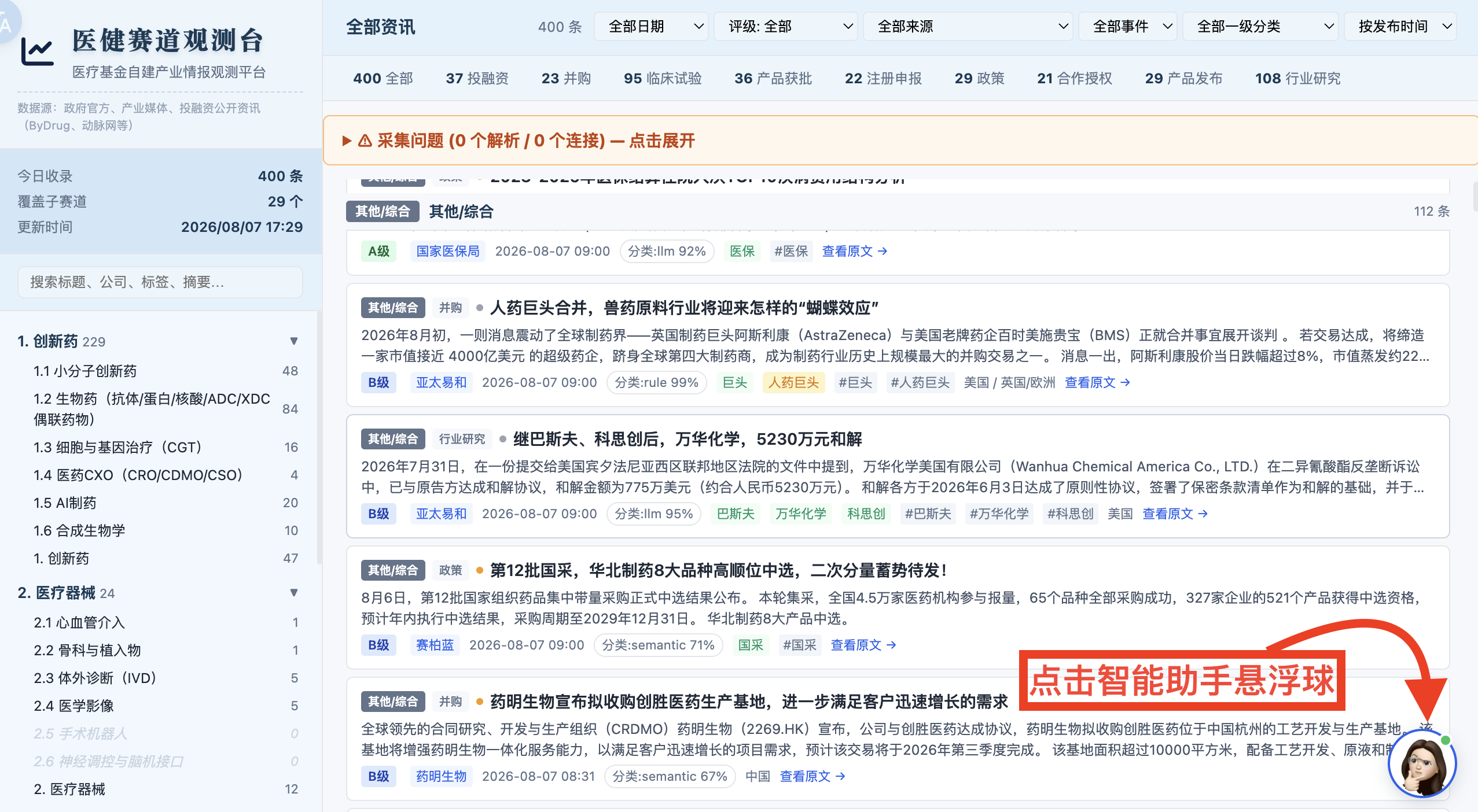
医疗信息监控 skill
monitor
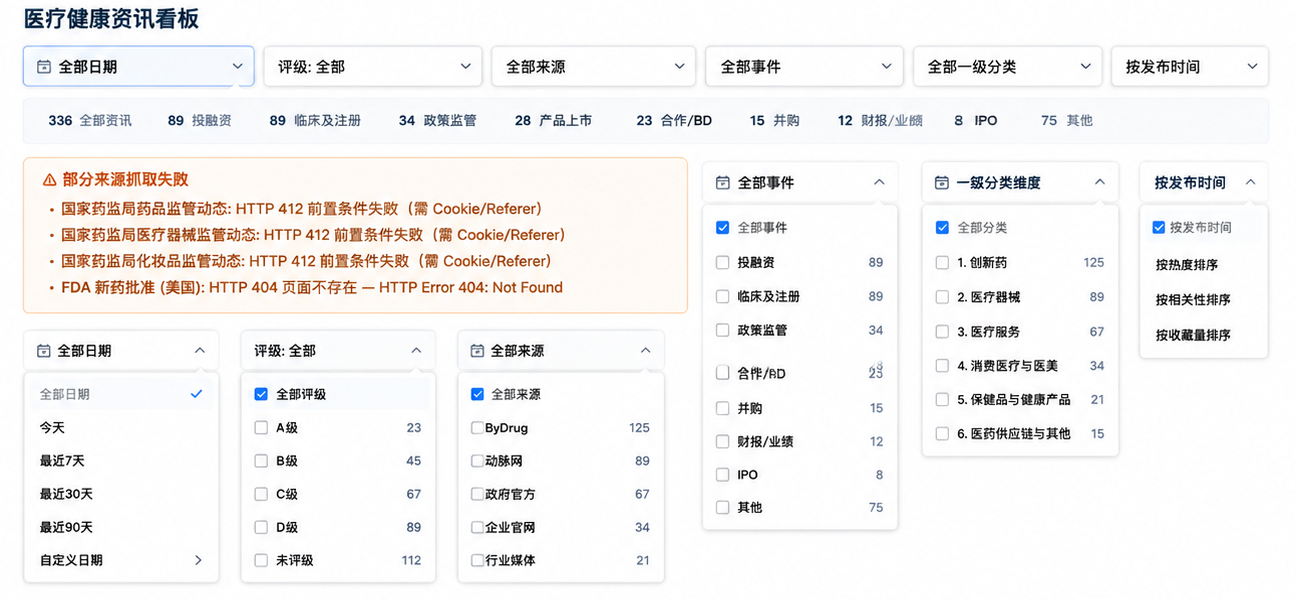
医疗新闻聚合看板:顶部标签与多维筛选 情报系统 dashboard 页面
Part 2 · 月报
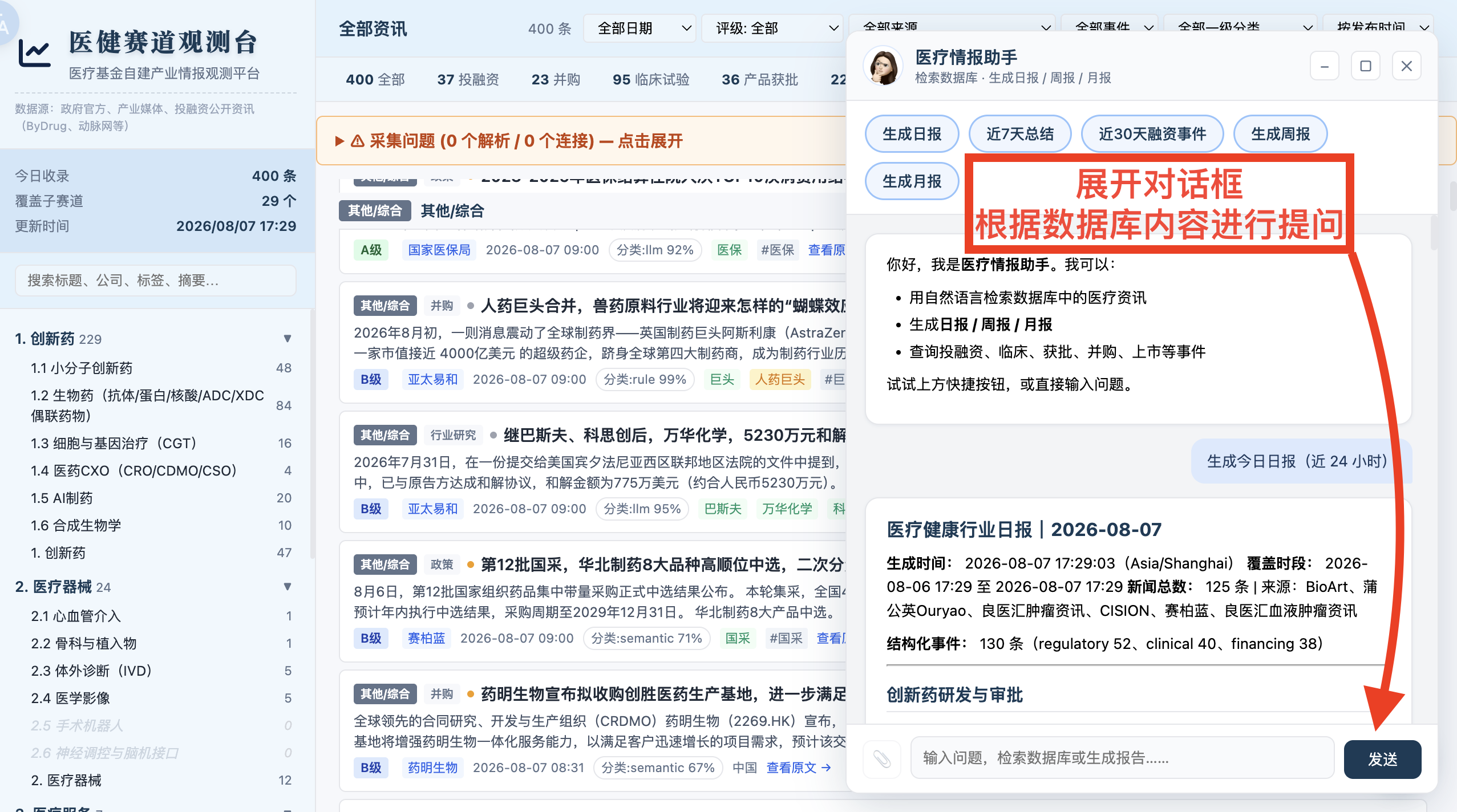
医疗行研月报生成 MCP + skill
report
医疗情报助手:一键生成日报/周报/月报
Part 2 · 排版
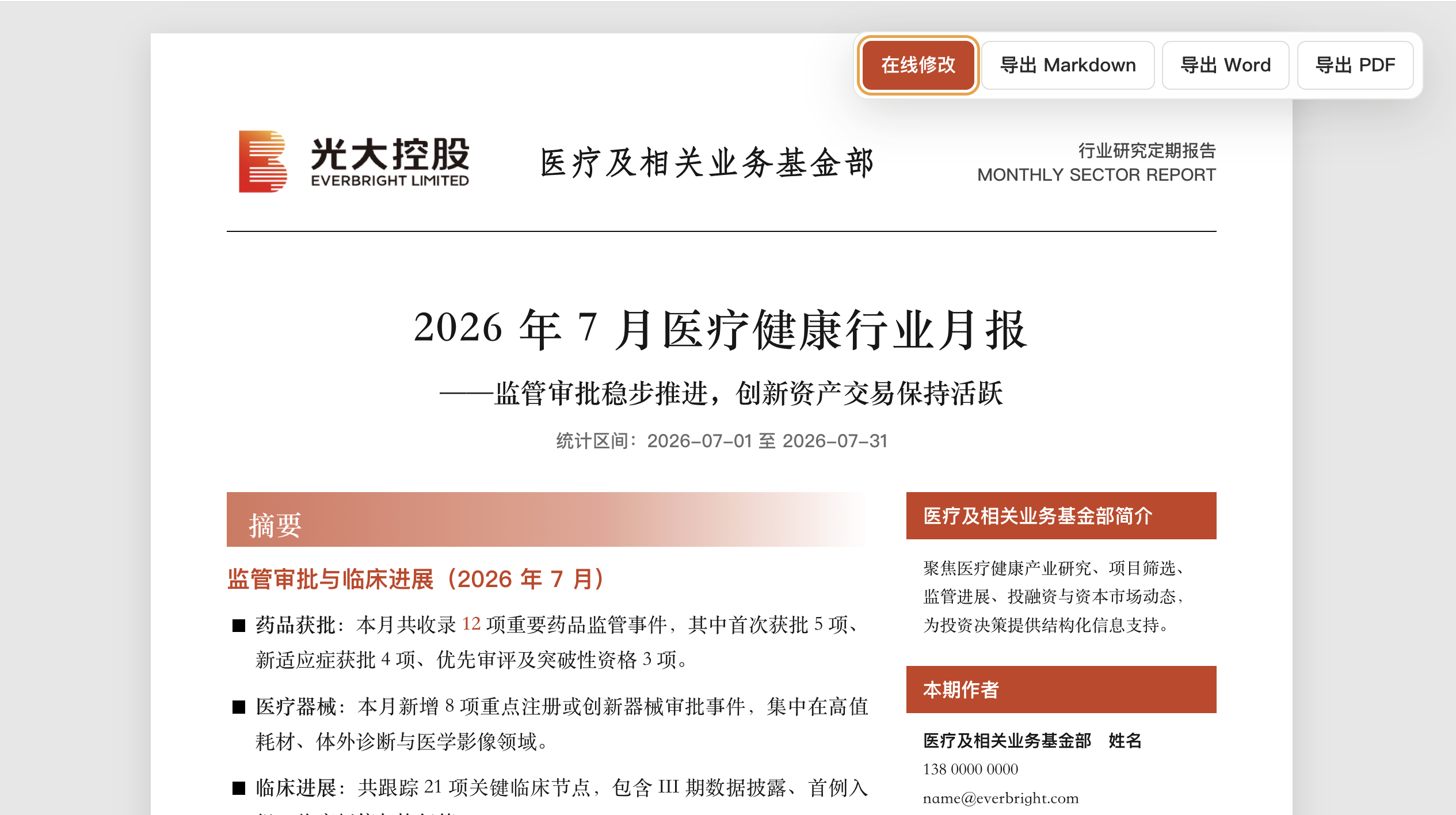
光大控股行研风格模板
template
光大控股风格行研月报:可导出 Markdown/Word/PDF
Part 2 · 投后
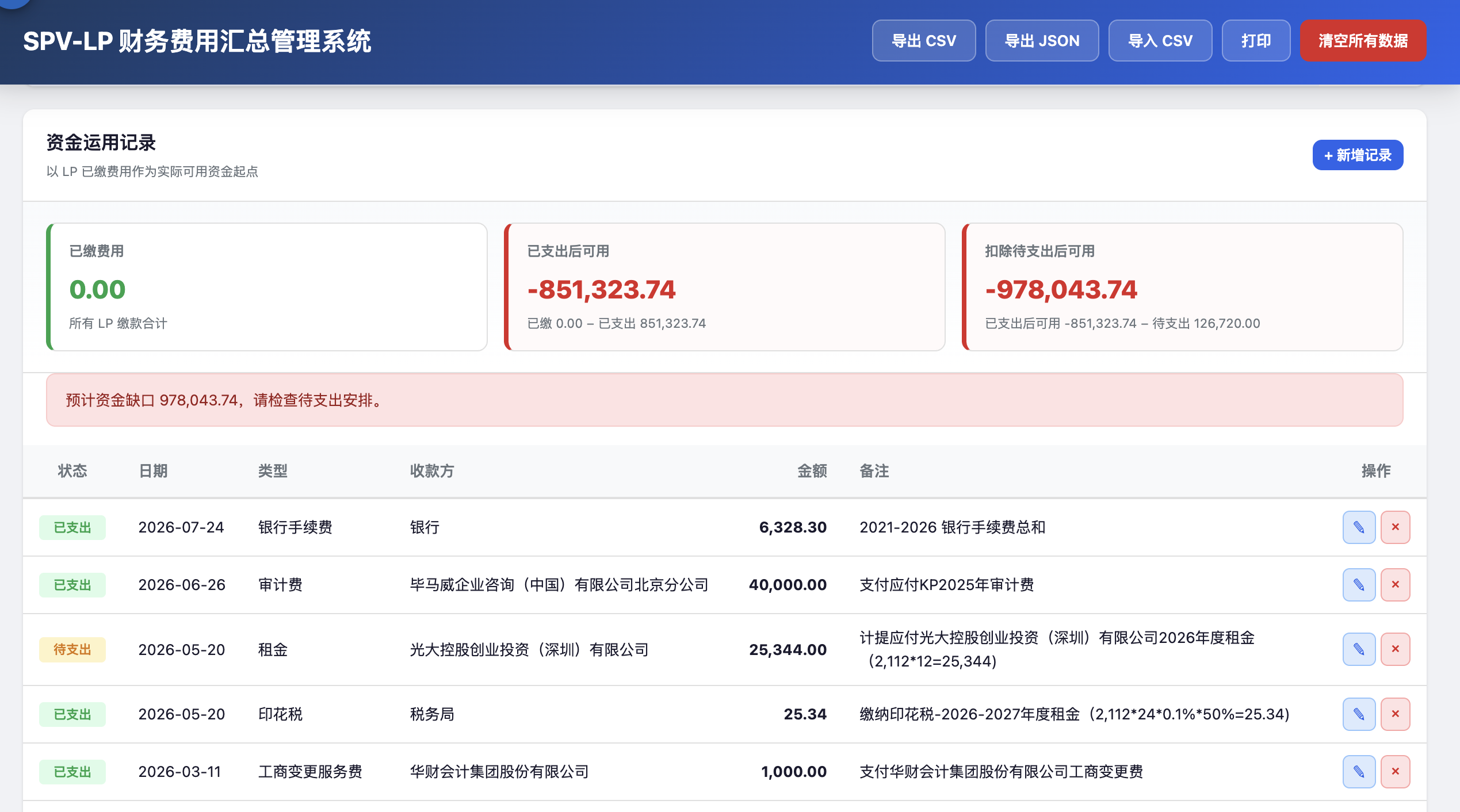
SPV-LP 投后管理系统
SPV-LP
SPV-LP 财务费用汇总管理系统
感谢聆听!
详见附后 —— 实习总结报告